The commerce landscape is shifting faster than anyone expected, and this week’s stories paint a pretty clear picture of where things are heading. Google is pushing checkout closer to the search bar with its new agentic flow, operators are rethinking how they manage retention and client expectations, and the funding environment is forcing every brand to sharpen its systems instead of relying on momentum alone.
Even with tighter capital and bigger competition, the brands and teams gaining ground right now are the ones who stay focused on the customer and use data to drive every decision. Whether it is guided discovery the way Trade Coffee does it, on-site testing with tools like Optimizely, or customer-first experience design from agencies like Barrel, the theme is the same. Build with intention, experiment often, and create a buying experience that actually helps the shopper.
This week’s Signals brings all of that together. Let’s get into it.
Google just gave us a preview of where checkout is headed.
Google quietly rolled out Agentic Checkout, an AI-powered flow that helps shoppers compare, select, and buy products without ever leaving the search experience. It is a small release with a big implication: checkout is no longer something that happens on your site. It is becoming something that happens wherever the shopper already is.
This matters even more heading into BFCM. Consumers are already relying on AI summaries, search snippets, and automated recommendations to narrow their options faster. Now Google is pushing the final step of the journey even closer to the search bar. That means product data, pricing accuracy, reviews, merchant feeds, and attribution need to be clean and consistent because shoppers won’t be landing on your PDP before making decisions.
💡 The question is no longer “will people shop through AI agents.” They already are. The real question for operators is whether your brand is ready for a season where discovery and conversion happen in the same breath, long before a customer ever reaches your storefront.
What’s the vibe across the D2C ecosystem right now?
A real look at how retention work is evolving and what it means for the rest of us.
This week’s post is one of those threads that hits because it captures what a lot of operators already know but rarely say out loud. Retention is still one of the most dependable revenue levers in the DTC stack, but the way brands work with agencies and channel partners is shifting. Expectations are rising, margins are tightening, and the market is rewarding people who keep their processes tight and their output tied directly to revenue.
For anyone running a brand or an agency, this is a reminder that clients want simple proof that the channel is working. Not long decks. Not endless creative cycles. Just clean execution, smart segmentation, and steady performance that holds up month after month. On the agency side, the ones who are winning are the ones who stay disciplined, set clear boundaries, and build a model that works across a lot of different types of brands without burning their team out.
Zooming out, the message is pretty straightforward. The operators who will win the next phase of DTC are the ones who treat retention like a system instead of a set of tasks and who understand the ecosystem well enough to move faster than the noise around them.
We’re data nerds so you don’t have to be. Each week we’ll bring you some data to chew on with The Data Drop.
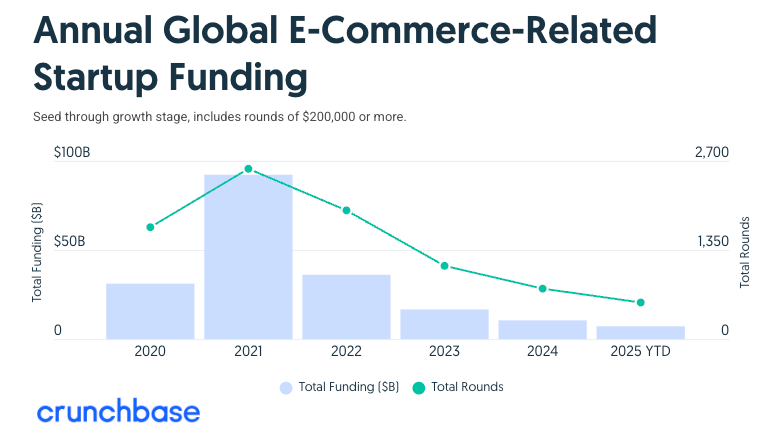
Funding for e-commerce startups is down 80%, but the opportunities are shifting… not disappearing.
Crunchbase reports that global e-commerce funding has fallen nearly 80% from its 2021 peak, with only $7.3B raised so far this year. At the current pace, 2025 will end as one of the lightest investment years the sector has seen in a decade.
This sounds bleak, but zoom in and a different story emerges. Investors are still backing companies that create real efficiency or unlock new buying behavior, especially in AI-driven commerce. The article points to platforms like Whatnot as proof that shoppers will always gravitate toward experiences that feel new, fast, or personalized. And as AI evolves, we can expect more startups to innovate around speed, discovery, and agentic shopping.
This shift matters for operators right now. With traditional funding drying up, the edge goes to brands that run lean, own their retention engines, and build smarter systems instead of chasing growth at all costs. And on the upside, a tighter funding environment also means less noise and fewer copycat brands cannibalizing your niche.
💡The lesson for operators: growth is still very much on the table, but the game has changed. Capital is no longer the tailwind. Discipline is.
One tool, one brand, one agency to watch out for this week.
If your caffeine routine needs an upgrade, Trade Coffee has you covered.
Trade Coffee built its business on something most brands talk about but rarely execute well: real personalization. Instead of pushing a one-size-fits-all product, they guide customers through a short taste quiz, pair them with small roasters across the country, and deliver beans that match their exact preferences. It feels thoughtful and curated, which is why customers stick around.
What makes Trade stand out is how quietly powerful the model is. They focus on quality, relationships with roasters, and a buying journey that reduces the usual decision fatigue around coffee. It is simple, predictable and built to keep customers coming back without relying on constant discounting or heavy paid acquisition.
💡For operators, there is a clear lesson here. Helping customers make confident choices will always outperform trying to overwhelm them with options. Trade Coffee shows what can happen when a brand invests in guiding the shopper, not just selling to them, which is more relevant than ever as assisted and AI-driven shopping continues to grow.
If traffic is changing, your on-site experience has to evolve with it.
With discovery and checkout becoming more automated and AI assisted, it is more important than ever to understand how people behave once they actually land on your site. Optimizely helps you do that without the guesswork. You can test almost anything on your pages and quickly see what lifts conversion and what slows people down.
It fits the moment we are in right now. Operators are tightening systems, trimming friction, and relying more on data to guide decisions. Optimizely makes that easy. Small experiments become weekly habits and those habits stack into better performance over time. It is a simple way to stay adaptable when the rest of the funnel is changing fast.
If you want to find more clarity in your site experience before heading into peak season, this is a smart tool to lean on.
When in doubt, start with the customer. Barrel does.
When your ads stop converting, it’s usually not the offer, it’s the creative. That’s where CreativeLaunch comes in. They help brands turn existing footage into high-performing video ads in under 72 hours, no production crew or long brief required.
Think of it as your on-demand creative team. You browse proven ad concepts (almost like a Netflix feed), upload your footage, and let their editors do the rest. Each ad is built to test new angles, boost conversion, and keep your creative pipeline full without draining internal resources.
💡 Why we’re watching: Consistent creative testing is what separates fast-growing brands from stagnant ones. CreativeLaunch gives operators a scalable way to keep ads fresh, data-backed, and ready to ship.
At 1-800-D2C, we spotlight the real builders behind the tools and brands featured on our site and the D2C players putting those tools to work. Let’s collab:
For Brand Founders:
List your brand on 1-800-D2C to show off your incredible tech stack.
Have an inspiring journey about building your brand? Get featured in our Under The Hood interview series and share how you’re scaling, innovating, and winning.
For Tool Founders:
List your tool on 1-800-D2C today to show off your brands and become a Friend’s Rates member. Sign up today.
Want to share the story behind your tool and how it's changing the D2C space? Fill out our founder questionnaire to get featured in our Behind The Tool interview series!